

Connected
Laundry
_edited_edited_edited.png)

Project Name
Next-Gen Connected Topload Laundry
Project Overview
Business & Products
The project aims to expand the business by integrating the Connected Ecosystem with primary Top Load laundry products. The main focus is on the North American market, with opportunities for future expansion Asia and Latin America.
This includes redesigning the physical product's HMI and enhancing the interaction with the App for both Whirlpool and Maytag brands.
Project Purpose
Developing an intuitive and cost-effective product line-up that incorporates a digital experience, thereby expanding the business beyond the traditional physical laundry machine.
Users & Aundience
-
Households mainly responsible for laundry responsibilities in North America (Canada, the United States, Mexico).
-
Executive leadership team and the board of directors.
My Responsibility
As the Product UX Designer assigned to the project, I took the main role in the below tasks:
Team Leadership
& Strategy
-
Directed UX strategy by synthesizing user and business needs into actionable design roadmaps for global categories.
-
Managed end-to-end delivery of all UX artifacts, ensuring high-quality handoffs were executed in scope and on schedule.
Process & Innovation
-
Established methodological rigor through scalable research protocols and workshops that accelerated innovation cycles.
-
Optimized interaction quality by developing standardized design patterns for complex hardware and software platforms.
Cross-Functional Collaboration
-
Orchestrated strategic alignment between engineering, product, and marketing to unify goals across matrixed teams.
-
Facilitated synchronization to evaluate ecosystem impact and ensure seamless execution from concept to global launch.
Stakeholder
Managerment
-
Influenced stakeholders across organizations by translating research into strategic recommendations that secured project buy-in.
-
Partnered with executive leadership to communicate design strategy, driving user-informed decision-making for long-term roadmaps.
DESIGN PROCESS
Iteration
Iteration
Objectives
& Scope
Discovery & Research
Define & Ideate
Test &
Deliver
Design &
Prototype
Launch
Cross-team
Collaboration
Cross-team
Collaboration
Impact & Measurable Results
UX Deliverables

Strategic alignment between engineering, product, and marketing.
-
Project Management: Project planning, stakeholder management and budget alignment
-
User Journey Map: Visualizations of the smart access ecosystem, showing how hardware, software, and services interact across the user journey.


Project Highlights
Navigating complex constraints and cross-functional stakeholder alignments by:
01
Promoting UX advocacy to harmonize project & business KPIs with user needs, optimizing control wireframes and interaction flows to reflect marketing needs without compromising usability .
02
Navigating complex safety and legal requirements to design intuitive user flows, successfully balancing strict compliance with a frictionless user experience.
03
Architecting a scalable, reusable component design framework that bypassed LCD technical constraints, reducing design-to-development handoff time by 20%
04
Accelerating project timelines by driving cross-functional alignment across executive leadership and stakeholder via low-to-high fidelity prototype reviews, effectively resolving conflicting feedback.
01
harmonize PROJECT & business KPIs with user needs
A: Project Scoping Workshops
To align with the broader roadmap and identify the project plan, scope, constraints, resources, and other relevant details, we organized and actively participated in multiple collaborative workshops with both internal and external stakeholders.
a. External Design Stakeholders

Platform Roadmap

Marketing Strategy

Technology Roadmap
b. Internal Design Stakeholders
_edited.jpg)
Industrial Trends

Consumer Insights

Design Guidelines
After align with the key stakeholders from project team, we’ve clarified the Project Objectives as follows:
-
Design the HMI for the TopLoad Premium Lineup of both Whirlpool and Maytag (Washer & Dryer pairs).
-
Integrate the connectivity and interactions between the products and the branded app.
With the project objective communicated back to the UX team and design leadership, I have requested the resources and set up weekly leadership alignment meeting.
A: UNderstanding Business Needs
At the request of the stakeholders, the project was initiated to specifically meet the following business needs.
1
Enhancing Development Efficiency
The team is required to develop two separate HMI hardware using the same software to optimize cost and time efficiency
2
Drive Connected Product Adoption
Leveraging latest BLE connectivity technology to create seamless interactions between the mobile app and the product HMI. Developing a connected appliance framework for future data updating and utilization
3
Activate Global Business Advantages
Allow global marketing access for additional regional production capabilities.
Enable multi-languages application for product software updates.
* Click to see more details
C: Scope Challenge and Proposed Solution
After the workshop discussions, I organized a meeting to share information with the UX design team and leadership. I identified the challenge for the project and shared the hypothesis to streamline the UX project development, communication, and handoffs.

Chanllenges
Based on the project development process, hardware development follows the Waterfall process, while software development employs Agile. This difference in methodologies can make it difficult to streamline deliverables and maintain effective stakeholder communication during the design phase.

Solutions
I have requested the necessary resources and collaborated with leadership to establish a “Milestone-Sync” development framework.
-
Integrated Roadmapping
Align software “Epics” with hardware “Gates” to finalize the user interface before the hardware freezes.
-
Tiered Design System
Develop a sprint plan with the development team, setting strict specifications for hardware-dependent elements while ensuring the software features’ flexibility.
-
Dual-Track Communication
Pair the Design & Project steering meetings with daily stand-ups to bridge long-term and agile goals.
-
Research Plan SYNC with Development Progress
Handoff the research plan to the development team and collaborate with stakeholders to build and test the prototype from low fidelity with customers, minimizing development timeline impact while ensuring UX design quality.
With leadership alignment on the hypothesis and project success criteria, the team move into the next phase.
2. Discovery & Research
A: Competitive Analysis
Technology Roadmap
Industrial
Trend
Marketing
Strategy
We conducted the Competitive Research focused on analyzing user preferences regarding competitor products. By leveraging data that aligns with Industry Trends, Marketing Strategy and the Technology Roadmap from project partners, we were able to refine our design directions.
B: User Persona and Mental Model
Through the analysis of research data and user personas, our team obtained valuable insights to strategically distinguish the experiences for Whirlpool and Maytag brands.


_edited_edited.jpg)
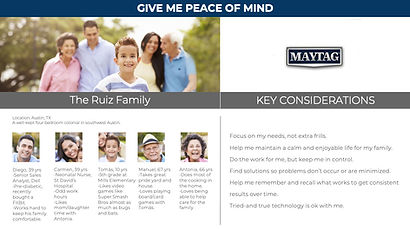


We have assessed and aligned the user interaction mental model using relevant data, ensuring that each aspect aligns with the brand's marketing strategy and user preferences.
C: User Problem Identification
-
Consumer Laundry Room
-
Laundry User Journey
Primary Design Focused Area

-
Laundry Room Renovation Trend

.jpg)
-
Product Ratings and Service Call Center Data


_edited_edited.jpg)

-
Top Laundry Product HMI Competitive Benchmarking
Through the analysis of current data on the laundry machine HMI usage environment, user journeys, and user feedback on key use cases we have identified both pain points and design directions.
-
Analysis of User Challenges with the Current Design

Whirlpool HMI
-
The touch zone is unclear, leading to misinterpretation of programs.
-
The lack of organization makes the interface visually cluttered.
-
The settings are difficult to read because of the materials used in the specific laundry environment.
-
Left-to-Right navigation make it easy to use
-
Modern and sleek appearance because of the non-knob interaction

Maytag HMI
-
User can't change any cycle settings when it's started
-
The knob HMI considered as easy to use.


App
-
The reconnect interaction is difficult if the machine is disconnected
-
Regarding the usage of customizable features, the inconsistent naming conventions and interactions between Product an App hinder remote monitoring and control of the machine
-
Enable to remotely control the machine
-
Knowing the cycle is ended on the phone
Design Directions
-
Improving the Product HMI information visual hierarchy
-
Offering straightforward interaction indication and feature naming
-
Providing consistency cross Product & App's HMI
-
Utilizing material, form and graphics to provide clear touch target on the product interface
3. Define & Ideate
Through the analysis of current data on the laundry machine HMI usage environment, user journeys, and user feedback on key use cases we have identified both pain points and design directions.
A: Hardware Development
Comply with the defined Interaction Principles.
_edited.png)


Utilize the Ergonomic & Technical Interaction Design Requirement


Collaborate with internal design team (Industrial Design, Graphic Design, Brand Design, CMF Design), as well as the external design stakeholders to IDEATE and REFINE the hardware design.


